
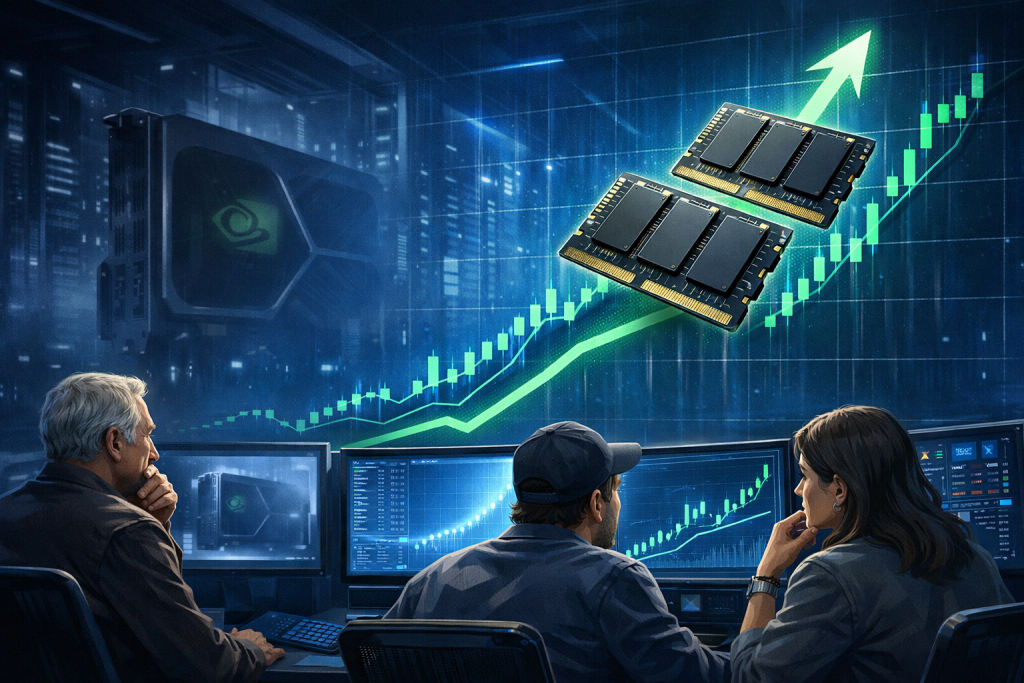
Nvidia’s long run at the centre of the artificial intelligence investment narrative may be facing its first real test, as investors rotate toward memory-product companies seen as key beneficiaries of the next phase of AI growth.
While Nvidia remains a dominant supplier of AI chips, recent market moves suggest attention is shifting to the components that support and enable those systems.
Announcements by Nvidia at the Consumer Electronics Show (CES) about its latest AI hardware failed to spark a meaningful rally in the company’s shares.
Instead, stocks tied to memory and storage surged, raising questions about whether the “picks and shovels” trade in AI is evolving—and whether parts of the market are overheating.
Memory makers take centre stage
Investor enthusiasm has increasingly focused on memory products, following comments by Nvidia chief executive Jensen Huang highlighting their importance for AI systems.
Shares of Sandisk, Western Digital, and Seagate Technology jumped sharply, with Sandisk gaining as much as 27% in one session.
The shift is underpinned by forecasts of tightening supply.
Counterpoint Research expects memory prices to rise by 40% to 50% in the current quarter, driven by demand from AI data centres and broader server expansion.
Samsung Electronics, one of the world’s largest memory producers, is expected to report that its quarterly profit more than tripled year on year, largely due to its memory-chip business.
Demand for memory is widely seen as less discretionary than demand for individual AI accelerators, particularly as AI workloads scale.
However, the speed of the recent rally has prompted caution among some analysts.
Cyclical risks and crowded trades
The memory-chip industry is historically cyclical, moving between periods of shortage and oversupply.
A Barron’s report said that investors jumping into memory chip stocks need to time their exits carefully due to the cyclical nature of the sector.
Analysts at Jefferies have warned that optimism around Sandisk may be misplaced, noting uncertainty over the market share of Chinese competitor Yangtze Memory Technologies as it ramps up production.
The rapid gains suggest retail investors may be piling into the sector, increasing the risk of a sharp reversal.
While higher memory prices benefit producers in the short term, they also raise costs for smartphone and laptop makers such as Apple and Dell Technologies, potentially weighing on consumer electronics demand.
If elevated memory prices persist, they could eventually compress margins even for AI hardware leaders, including Nvidia, which relies on these components in its systems.
Nvidia waits for the next catalyst
Nvidia’s shares have lagged the latest AI rally, falling 0.5% during Tuesday’s session and remaining down about 1% over the past three months, despite a modest pre-market rise to $188.41.
Investors appear to be waiting for clarity on two fronts: approval to sell its H200 chip in China and confirmation of major new orders from US customers.
Huang said at CES that production of the H200 chip is ramping up and that licensing discussions with the US government are nearing completion.
Nvidia already has orders for more than two million H200 chips, implying roughly $54 billion in revenue, according to Reuters, though sales to Chinese buyers remain uncertain.
Potential upside could also come from xAI, Elon Musk’s artificial intelligence company, which recently completed a $20 billion funding round.
xAI already operates more than 200,000 Nvidia chips at its Memphis data centre, with plans to scale to at least one million GPUs.
While the AI investment theme remains intact, the market’s rotation toward memory highlights the risk of chasing crowded trades.
For now, Nvidia remains central to AI infrastructure, but the spotlight is no longer exclusively its own.
The post Why investors should be wary of memory chip rally as Nvidia loses AI spotlight appeared first on Invezz